Mussel Boats at the Upstairs Landing
Page 113 of 245
Chapters
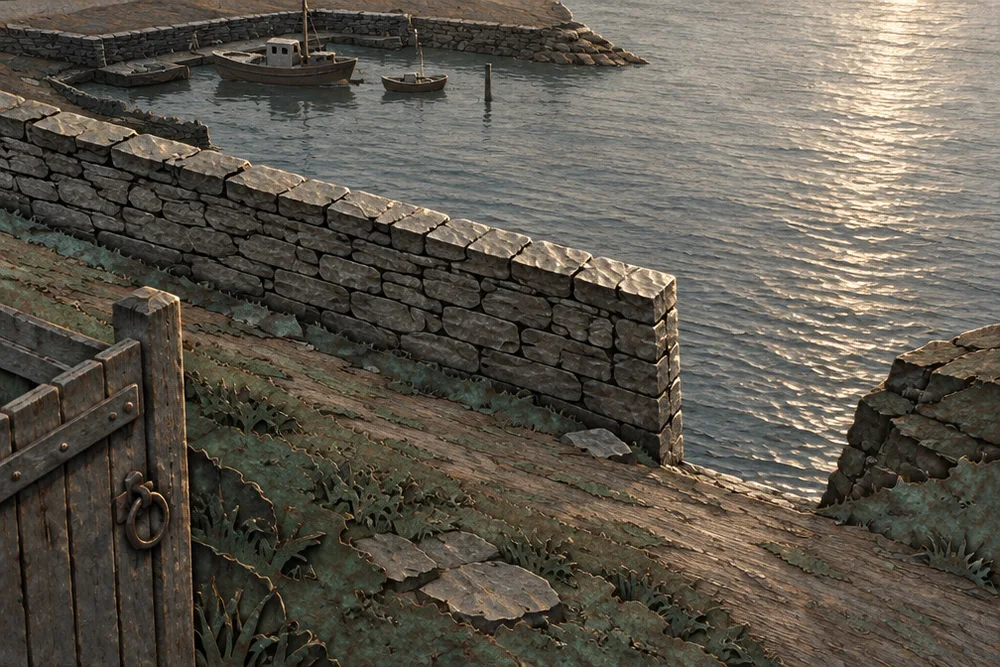
The saw went on. Outside the shed, a cart creaked along the road that ran down toward the basin. Someone called a count, and the answer came back faint through the yard gate. Work had resumed on the harbor; stone was moving while the village tried to decide what shape its future could bear.
Tomas imagined the narrow entrance as a dark line between new walls, the tide tugging through it both ways. A pilot could not make a passage wide. He could tell a skipper when to wait, when to turn, when to give up a crossing rather than lose a hull. It was a small authority, bounded by water and weather, and he had missed having even that much to offer.
By late afternoon, they had fitted the new board loosely against the ferry’s open side. It still needed shaping and fastening, and the ribs would need attention before the boat could be trusted. Nera wrote the next day’s tasks in the ledger, then covered the hull with canvas against the evening damp.
Tomas walked to the yard gate and looked down toward the slip. A handful of villagers stood by the voting shed, where the ballot board had been taken inside. Beyond them the wall rose in an unfinished length of stone, its end stopping short where the passage would be. The opening looked too narrow from here. Everything looked narrow when seen from uphill.
Nera came to stand beside him. Her hands were blackened with sawdust and pitch. “The ferry won’t be ready for a loaded crossing tomorrow.”
“I know.”
“But we can begin the repairs.”
“And I can sound the route.”
She nodded. “You’ll need a pole and someone in the bow.”
“You?”
“I’ll be checking the hull after.”
“Then someone else.”
“We’ll find someone.”
Tomas watched a gull drop toward the water, then wheel away from the wall. “I’m not promising I’ll take every job you offer.”
“I’m not promising to offer every job.”
They stood quietly until the gull settled on the roof of the voting shed. Tomas had spent years making decisions alone, with a ferryload of people trusting him to read water they could not see. This would be different. The route belonged to the crews, the wall to the village, the repaired boat to whoever could keep it afloat. His part was to learn the new passage alongside them.
“Tomorrow, then,” he said.
“Tomorrow.”