Love in the Offcuts
Page 56 of 161
Chapters
“If the velvet goes here,” she said, “the medium-weight brown can balance it on the other side. The two lightest bays stay at the ends. That gives us less swing when the doors open.”
“And the track?”
“You brace that bracket. I can’t make the fabric compensate for a bad rail.”
“Fair.” He took a short length of sound timber from the offcuts pile and trimmed a shim to fit behind the bracket. The wood was dry and close-grained, a remnant from a window frame. He worked it in carefully, testing the bracket before he put the screws back.
Their knees touched as they leaned over the drawing of the bays. Neither of them moved away at once. The contact was brief, ordinary, and somehow harder to ignore than the loud complaint of the track.
Marek sat back. “I’ll make the next brace removable. If the buyer takes the rig, it comes with a fix that can be inspected.”
“If the buyer takes the rig,” Leonie said, “they’ll have to take the curtain down first.”
He looked at her. “You’re planning on the show.”
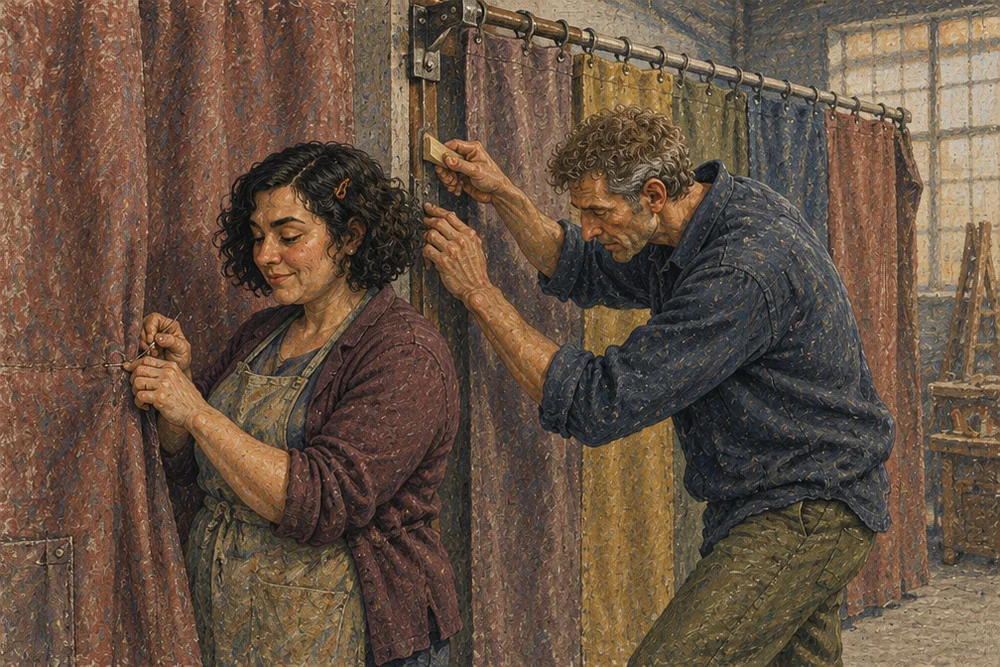
“The show has been the plan all week.” Her mouth tightened, not quite a smile. “I know there’s a sale behind it. I haven’t forgotten.”
“I haven’t either.” He turned the screw until it sat flush. “I’m trying not to treat the sale as if it’s already happened.”
She returned to the cloth. For the next hour they spoke mostly in measurements. She named widths and weights; he answered with clearances, rope travel, the inches between the trolley and the bracket. The work kept their hands busy and their choices visible. Where one of them proposed a change, the other could test it instead of guessing what the proposal meant.
When they hoisted the panel again, it rose without the sharp lurch. Marek worked the rope in short, even pulls, watching the trolley travel over the repaired section. The curtain’s lower edge shifted as the cloth took its weight, but the new arrangement kept it level. At the top, the panel cleared the stage lights by a handspan.
“Hold,” Leonie called.
He stopped. She walked beneath the suspended cloth, checking the seams and the drop. At stage left she crouched to inspect the lower edge. A small repair flap sat there, accessible from the side, where a dresser could reach through to fix a hem without stopping the whole show. Leonie had insisted on keeping it, even when it complicated the layout.
“The flap’s clear,” she said. “And the edge isn’t pulling.”