Keep a Cup for Nobody
Page 62 of 269
Chapters
Ada brushed the crumbs from her palm into her other hand, picked out a short thread and dropped it on the table. Willa almost asked her to leave it. It was only a thread. Ada pinched it up again and put it with the crumbs. Neither of them had touched the shelf while Kit was there.
Willa let go of the latch. She crossed to the shelf and slid her hands under the overhanging ends of the towel.
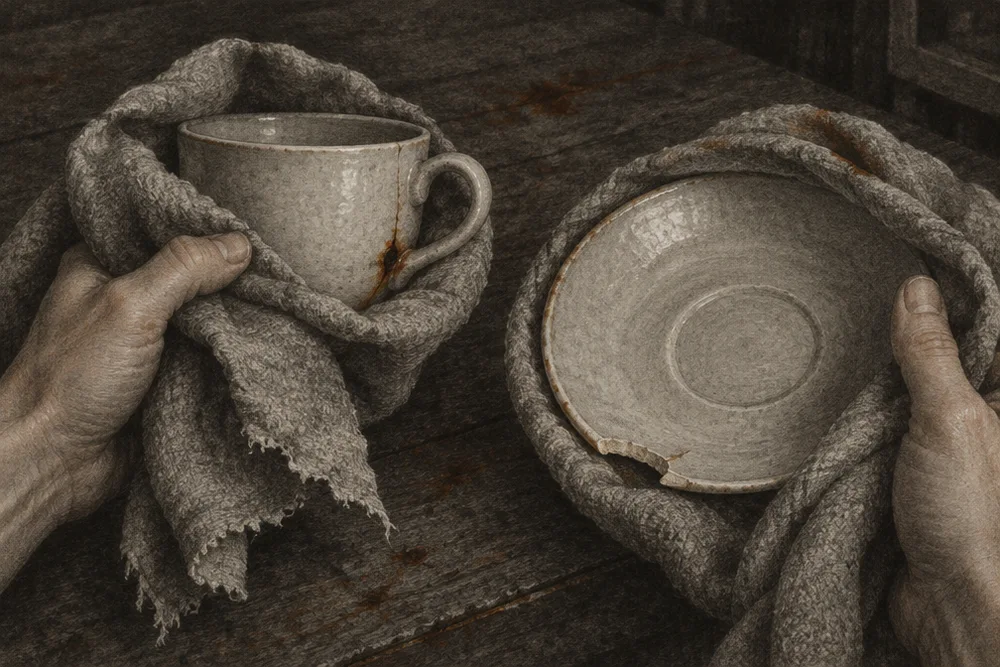
Willa took the towel-wrapped cup from the shelf. It was lighter than she expected, even with the saucer beneath it. She held the two pieces apart, one in each hand, wrapped enough not to touch. The china gave off no warmth. The rust bloom below the handle was a dark spot against the bone-white glaze.
“Did you carry it to the water?” she asked.
“Yes.”
“Did you throw it in?”
“No.”
“What did you do?”
“I set it on the landing. He told me to send it away. I took it as far as I could without putting it in the sea.”
“Then what?”
“The tide came in.”
“And the cup?”
“Was gone by morning.”
Willa imagined the saucer on wet stone, the water lifting over it, a small white shape disappearing into the sound. “You said you knew it could ring.”
“I heard it once before I set it down.”
“When?”
“At Nine Step. Your father had left it on the table. I went to clear it. The cup moved against the saucer when there was no one near it.”
“Why didn’t you tell him?”
“I did.”
“What did he say?”
“That it was the house settling.”
The answer struck Willa as precisely the kind her father would give: not a lie, exactly, but a door shut with a familiar hand. She could remember the rumble of his voice through the kitchen, a warmth that had gone with him when he died. She was still angry with Ada for not telling her. She was beginning to understand that anger could be true without being the only thing true.
“If the cup was in the house when it rang, what happened?”
“Nothing I could see.”
“What happened after you sent it away?”
Ada’s gaze moved to the towel in Willa’s hands. “I don’t know. By then, everybody had already started forgetting.”
The china stayed silent between them.
Willa set the saucer down on the table and kept the cup in her palm. The weight of it seemed to demand a decision, although it had no right to. It was an object. A cup did not remember, did not choose a destination, did not take anyone’s memories away. Yet the saucer had rung in an empty cabin, and passengers had lost the faces of people waiting ashore.