Keep a Cup for Nobody
Page 211 of 269
Chapters
They walked on. Kit held the tin carefully, listening to the starter's quiet living movement under the lid. Each step carried them farther from the ferry and closer to a house he could not picture. He had been given directions in the cabin, on a scrap of paper and on his own wrist, and the words stayed with him even when the feelings did not. Home. Husband. Walk beside us.
The man did not fill the silence with stories. Kit was grateful for that, though he could not have said why. A story might have made a claim: you remember when, you loved this, you promised. Instead, the man watched the path and let Kit decide how much space to leave between them.
Behind them, someone called a name with great certainty. Someone else answered, not quite as certain. The sound rolled across the quay, followed by a pause and then the first person's gentle repetition. Kit did not turn. He could not help them by watching.
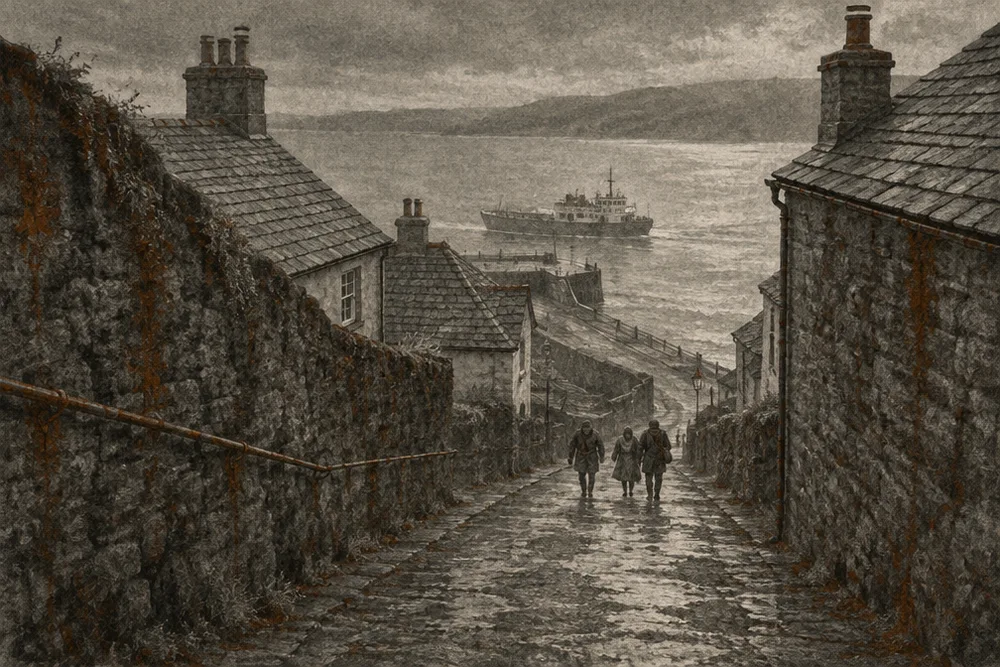
At the edge of the quay, Kit stopped again. Not because he wanted to turn back, but because he had reached the place where the boards gave way to the packed lane and did not know which way to go. The man waited. Iona had already spotted the road that climbed away from the water, but she did not tug Kit along.
'Which way?' Kit asked.
The man pointed uphill. 'Past the cooper's yard. Then the lane by the green door.' He lowered his hand. 'I can show you. If you want.'
Kit looked at Iona. She did not answer for him. That was the point of what she had said, he realized; she could stand close, she could keep the coat, she could insist that he not mistake confusion for illness. She could not choose whether this man walked beside him. That had to be Kit's choice.
'Show us,' Kit said.
The man turned uphill but kept the pace slow. Kit followed with Iona beside him. The coat swung gently from her arm. It was dry, and the fact of its dryness suggested someone had put it somewhere warm rather than leaving it folded on a chair. Kit could almost imagine a kitchen, a chair, the coat waiting there. The image had no people in it.
'What's your name?' Kit asked.
The man looked over his shoulder. 'You know my name.' Then, seeing Kit's face, he said, 'I'm sorry. It's Orr. Same as yours.'
Kit repeated it silently. Orr. It fitted the bread tin's label only because both belonged to him; it did not tell him anything about the person walking beside them. But it was a place to begin.