Keep a Cup for Nobody
Page 163 of 269
Chapters
The man’s eyes narrowed. “Tomas.”
“And you’re sure he’s at the fish ramp?”
“He told me.” The man patted his coat pocket, then brought out a damp scrap of paper. The ink had run at the folds. “Here. He wrote it when I left.”
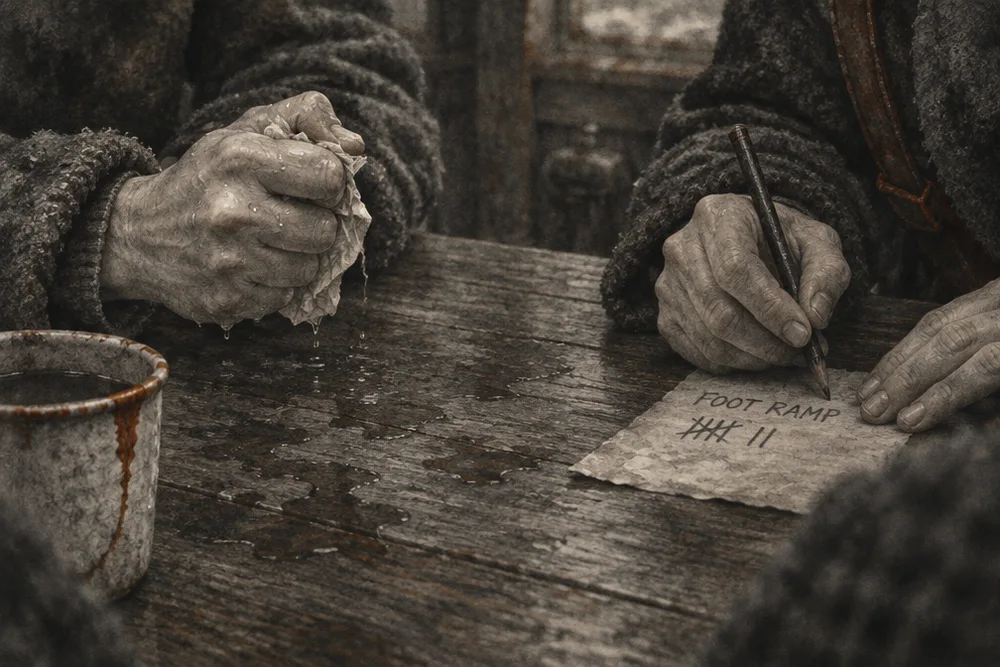
Jory took care not to snatch it. In the cabin’s wavering light, the note was still legible: Foot ramp. I’ll be there. A rough arrow pointed toward the landing, not the fish-cart side. The man had looked at the word and remembered the wrong ramp anyway.
“That says foot ramp,” Jory said. “Tomas is at the foot ramp.”
The man read the note again. His lips moved over the two words. His face tightened, not with recognition but with the effort of trying to force it. “No. He said fish.”
“Maybe he said the landing. There are two ramps.”
“I know my own son.” The man snatched the scrap back and folded it until the wet paper nearly tore. “Don’t make it into something it isn’t.”
Jory could feel every pair of eyes that had turned toward them. The cabin was full of people trying not to look as if they were listening. Kit had a hand on the bread tin lid. Iona’s round eyes were fixed on the stranger’s folded note, as if she might read the truth through his fist.
“I’m not saying you don’t,” Jory replied. He kept his voice low. “I’m saying the note points to the foot ramp. When we land, there’ll be somebody there to help you check.”
“I don’t need help.”
“Then you’ll have someone to meet.”
The man looked away. The sentence had landed badly, but Jory let it stand. His first instinct was to explain, to make the facts gentle enough that the man would accept them. Willa had taught him that people at sea did not always need a softer fact. Sometimes they needed time to decide what they could do with it.
He wrote FOOT RAMP beside the man’s name. His pencil shook as the boat shifted, and the line came out crooked. He did not erase it.
“How many are meeting somebody?” Iona asked.
“That I know about?” Jory said. “Six, maybe.”
“You should ask everybody.”
“I have been.”
“Not like that. You ask who’s coming. You don’t ask if they’ll know them.” Iona said it with the blunt certainty of a child who had already spent the night arguing with an adult she loved. “People can have names and addresses and still not know who’s standing in front of them.”