Bus Stops and Spin Cycles
Page 26 of 204
Chapters
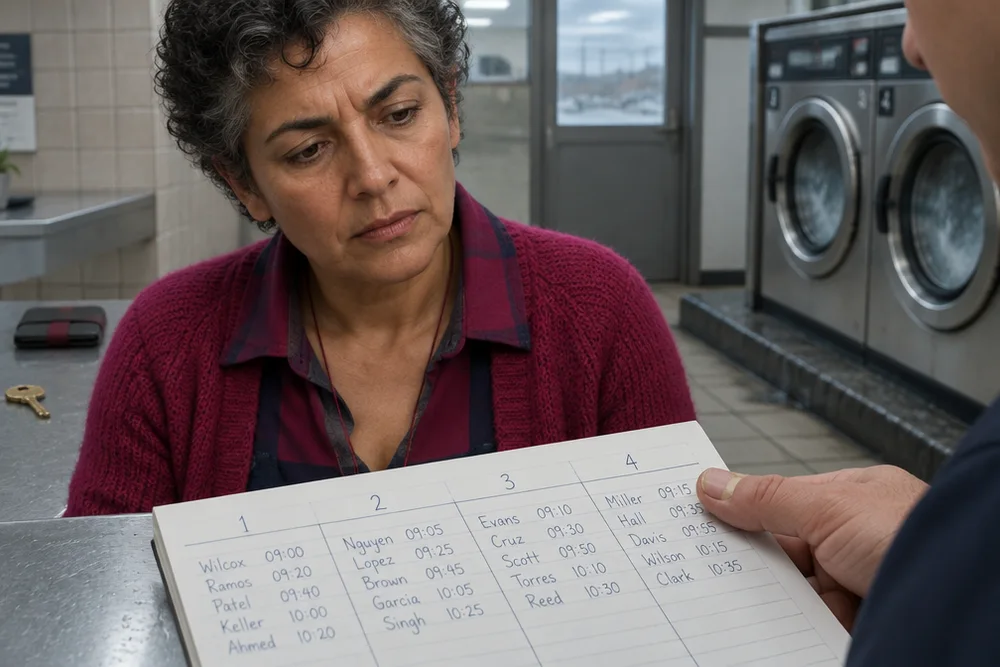
The hours on the door said seven on weekdays. She checked the price board, then checked it again because the small machines cost less than hers. Four of them stood along the wall. Two were running. The other two had cards tucked into their handles, each with a time on it.
A man behind the counter was pinning the cuff of a school jumper to its sleeve. He set the pin crosswise and looked up.
“Have you got a wash coming in?”
“Not today,” Triana said. “I wanted to see how you do bookings.”
He turned a ruled pad round on the counter. Across the top he had written the washer numbers. Under each was a list of surnames and times. He left a five-minute gap between loads. Triana wouldn’t have trusted five minutes even with new machines, but she kept that to herself.
“Say somebody wanted a small one first thing on a weekday.”
He turned back two leaves to show her a row of names. “Those are regulars. I could give you a big one.”
“For one uniform and some towels?”
“It’ll wash them. I can’t charge you for half a drum, though.”
She looked up at the board. The big wash was almost twice the price of the small one. He hadn’t pointed that out, but he hadn’t hidden it either. It was printed in the same size.
“What if it was four people?” she asked. “Could they get four machines at once if they booked ahead?”
The man held the pad open with the heel of his hand. His nail was split down the middle and bound with clear tape. “On a Tuesday I might get you two. Would they want every Tuesday?”
Triana almost said yes. It would have been easy to leave with two names on a sheet and tell Salma she’d found a start. Then she thought of Iva in front of washer four, counting the uniform she had left. She didn’t know which mornings Iva worked until Iva came through the door.
“I don’t know,” she said.
“Give them the number. They can ring when they know.”
He pulled a card from under the till. On the back he wrote the first time he could usually offer on a small machine. It was forty minutes after opening. Then he underlined ‘usually.’
A customer came to the counter with a washer card and asked for ten more minutes. Her son had taken the wrong bag downstairs. The man checked the pad before saying yes. Triana watched him rub out a time and put it back in again farther down the column. He did it neatly, as though he was used to making a small allowance without promising it to everybody.