Borrowed Wings over Cinder Pass
Page 56 of 222
Chapters
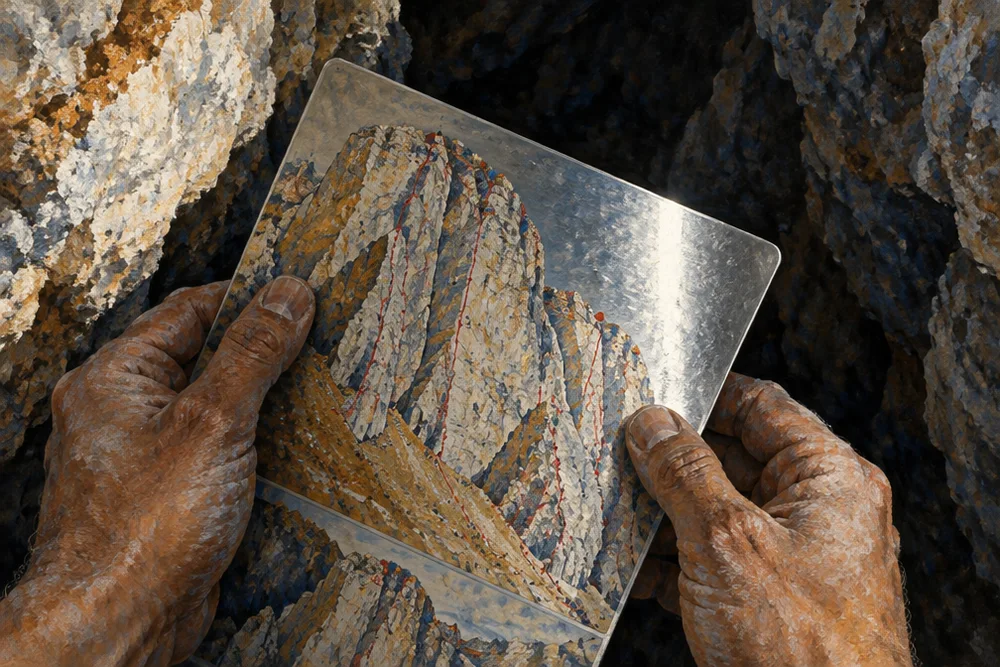
She had taken the private turn because she believed the stair’s upper mouth would still take a glider to its landing. The route was not improvised in the air. She had walked its visible approaches, checked the heights from the ground, and marked the turn on this card. She had not told the hired camera crew. She had not told Iven Cault.
Niko had been told enough to repair the wing and nothing about the route. That distinction had seemed reasonable at the time. He knew the glider better than anyone on the hill; he did not know the pass as a guide knew it. Sella had assumed she could carry the risk without handing it to him. Now the shed mirror answered from beyond the rib, and that assumption had become another weight she had to account for.
She turned the card over. The silver backing gave her a dim reflection of her own face: high temples, dust on one cheek, chin tucked as always. Under the reflection, her thumb found the sketch she had drawn before the flight, a rough side view of the Ash Stair’s upper traverse and its old landing.
The upper mouth had been above the line of sight from the turn. She had known that. She had counted on the stair continuing down behind the rock, where its surviving lower landing met the old workers’ traverse. In the air, she had seen the mouth collapse only when the blind rib was already between her and the public side.
The card’s old sketch was still there, the ink blurred at one corner. A line climbed from the lower landing toward the upper mouth. Beside it she had written the measurements she had taken from the approach: rough distances, a note about loose stone, a warning to stay right of the seam.
She had trusted those measurements. She had not trusted the view from the Ticket Shelf, where two gullies compressed into one and a bright marker seemed to sit exactly where a pilot would need it. Sella had been wary of that view before the demonstration. She had even told herself the markers were for the crowd, not for her.
But the private line she had chosen depended on the old stair being passable at its upper mouth. The turn had avoided the public notch; it had not avoided the collapse. She had treated the surviving lower landing as proof of a continuous route, because the old traverse had once connected them. Once the wing dropped behind the rib, there had been no angle from which to check what the rock had done.