A Kiss in the Wrong Subtitles
Page 74 of 162
Chapters
“We can add a reaction cue,” she said. “Not say what he knows. Just make the timing legible.”
Soren leaned over the laptop, reading the waveform. “I can place a short description after the bell. ‘He turns toward town.’ But that may duplicate the visual.”
“It’s not a duplicate if the purpose is the connection.”
“Maybe: ‘At the bell, he turns toward town.’”
Nell looked from one to the other. “That tells me the bell matters. It doesn’t tell me why.”
“The key in the next shot carries the rest,” Pia said. “We can’t put the answer in the trailer without spoiling it.”
“Good. So you’ve found the actual problem.” Nell’s voice had no triumph in it. “Not that you failed to write a caption. That the two tracks both treated the bell as background, when the film uses it as action.”
Pia looked at the cue sheet in her hands. There was a thin grey line where the bell sat, marked AMB, for ambient sound. She had put it there because it was not dialogue and did not need a full caption. The classification had seemed objective. Now it felt like a choice she had made without noticing.
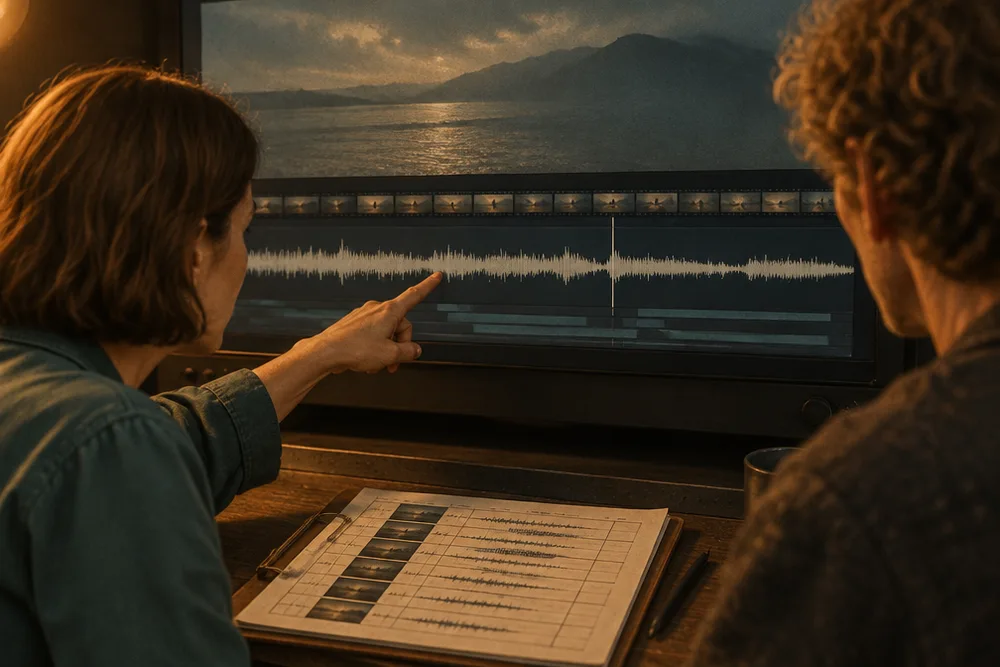
“Can we test a revision?” Soren asked.
“That’s what I’d do,” Nell said. “And don’t test only with people who already know the film. Give them the trailer once, ask what they understood, revise, then try again. Pay them for their time.”
Pia wrote the sequence in the margin of the brief: first view, question, revision, second view. Underneath, she wrote the words Nell had used: what changes for an audience.
The first draft of the revised cue read: [A dock bell clangs. The man turns toward town.] It was clear, but it sat over the moment when the woman’s face tightened. Soren’s description landed a fraction later, crowding the cut to the key.
Pia read the cue aloud while he played the trailer. “A dock bell clangs. The man turns toward town.”
“It sounds like instructions for a machine,” Nell said from the front row.
“It’s a caption,” Pia said, then heard the defensive edge and let it go. “What would you change?”
“Maybe nothing. I’m telling you what it sounds like, not asking you to make it pretty. I want to know what the audience needs and what you can afford to give them.”