A Kiln for the Ferry Queue
Page 95 of 220
Chapters
“And if we take on the baths, the boat crew won’t become your caretakers.”
“They won’t. I’m pricing cleaning separately.”
Mina studied Cora’s face for a moment. “People have come to us before with a good idea and an assumption that the cooperative can carry whatever the idea cannot.”
“I’m not asking you to carry my school.”
“You’re asking us to take the lease.”
Cora could not argue with that. The lease would be the cooperative’s responsibility, and the right to take it did not turn the building into hers. She could imagine a kiln, a wash station, the tables arranged around the old hall. She could not make those images evidence that the rent would always arrive.
“Yes,” she said. “I’m asking you to consider it. If the numbers don’t work for the cooperative, I need to know that before I promise anything.”
Mina’s expression shifted, not softening so much as settling into the seriousness of the choice. “I’ll tell you what the members say. Don’t spend the deposits.”
“I won’t.”
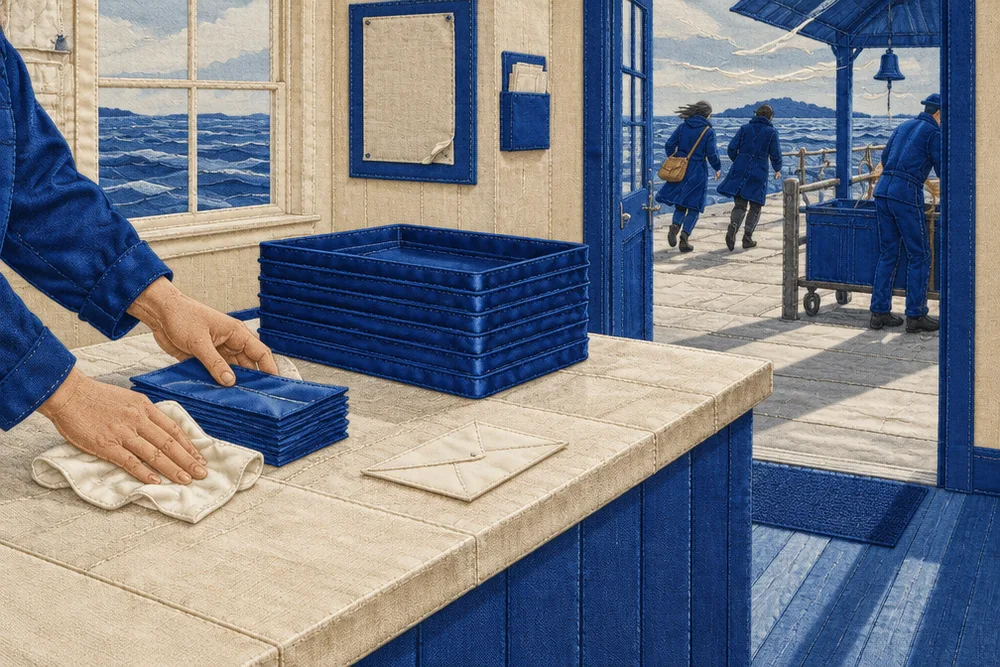
Cora left the clean sheet with her and took the notebook home. Outside, two passengers hurried toward the landing as the boat’s warning bell sounded. The wind worried at the corners of the posted timetable. She watched the crew pull the ticket tray back under the shelter roof, then turned uphill toward the Hem Room.
The market stall was already gone. The Saturday course was full, but it would not run until the building was usable. The revised Thursday class had fewer names than the first version, and the ferry could still make it difficult for those who wanted it most. Cora had not found a way to make the numbers kind. She had made them honest enough to carry into the next meeting.
At the Hem Room, she cleared the counter for the evening students. A beginner pressed a thumb into a lump of clay and looked up, unsure whether to keep going. Cora stepped close, but did not take the clay from her. “Turn it a little,” she said. “You can decide what the shape needs once you can see it.”
After class, Cora waited for the last student to wash the clay from her fingers. The pressing tables would be back in use by morning; there was no room to leave tools out or work through the night. She stacked the bats, wiped the counter and put the refundable deposits in a separate envelope. On its front she wrote DO NOT SPEND.