A Kiln for the Ferry Queue
Page 19 of 220
Chapters
At the corner of the baths she turned toward him. “You said the key was for a survey.”
“It is.”
“And the renovation budget?”
“Conditional on the firm’s grant. The council’s rent relief is separate.” He paused. “I can send you the breakdown in writing.”
“Please do. I don’t want to find out later that an offer had strings I wasn’t shown.”
He heard the carefulness in her voice. “You won’t have to take the offer.”
“I know that.” She adjusted the cuff at her patched elbow. “But if I’m named as part of it, I need to know what I’m being named for.”
He had been about to say that the launch slot was provisional. The explanation would be true and insufficient. He said, “You’re right.”
She looked past him to the landing, where the shelter roof rattled lightly in the wind. “Show me the queue route again.”
They walked the route from the proposed upper entrance to the ferry shelter, measuring it in turns and obstacles. The shelter was three-sided, its bench full and its ticket tray empty except for the wet imprint of a paper stub. A passenger shifted to let another person take the dry end. Neither had room to stand without blocking the path.
“This would be the waiting area?” Cora asked.
“The bathhouse could serve as one, if the council approves the use.”
“And if someone’s crossing late?”
“They’d need clear signs and a call system. We haven’t designed that yet.”
“Then don’t call it a waiting room on a launch sheet.”
Piers felt his face warm. “I won’t.”
He could have told her the firm had not asked him to use that phrase. It would have been an evasion: he was the one who had filled in the running order, not Ruth. The launch was three days away. He had pencilled Cora’s name because he could already picture her there, speaking plainly about evening classes and the bathhouse. He had not imagined her having to stand beside a claim about access that stopped at a contract boundary.
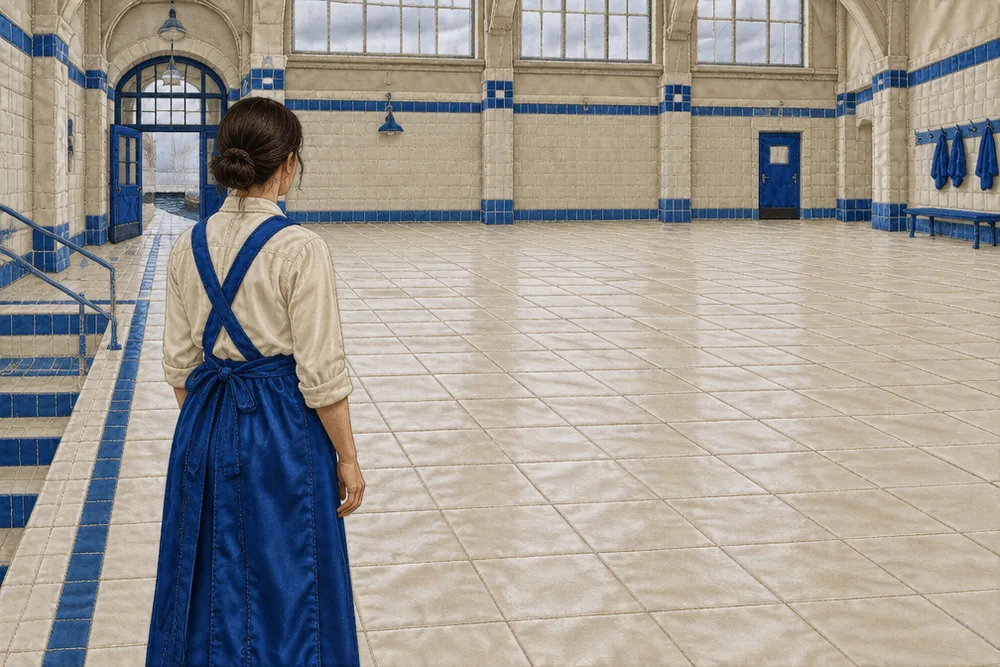
They returned to the baths by the service entrance. Cora asked to see the hall once more. In the drained plunge space she stood where a pottery wheel might go, then turned to look at the entrance, the laundry door and the length of clear floor between them. “A school would need room to work. A waiting area would need somewhere for people to sit without being in the way. I haven’t said I can make both fit.”