A Kiln for the Ferry Queue
Page 143 of 220
Chapters
“You can’t make the turn and read the board at once,” she said. “If I have to stop here, people come up behind me.”
Mina moved the ticket table half a pace. That cleared the chair, but the queue bent across the doorway to the old laundry. Ede opened the door to check the route from the hall to the washroom; its swing swept into the waiting aisle and nudged the back of the bench.
“That door is going to keep catching people,” Ede said.
Piers marked the conflict on his paper. The tape made the problem look small. The actual door had weight, and a hard edge, and a habit of claiming space. He resisted the urge to propose a pocket door. A new door would cost money and require consent; the task today was to find what passengers needed before he drew another answer.
The timer sounded. Beyond the high windows, the boarding call carried from the landing, blurred but unmistakable. The deckhand stepped into the role of passenger and moved toward the ticket table. The wheelchair user followed, then paused where the queue narrowed. The shopping trolley’s clicking wheel struck the bench leg.
“This isn’t a queue,” Mina said. “It’s a knot.”
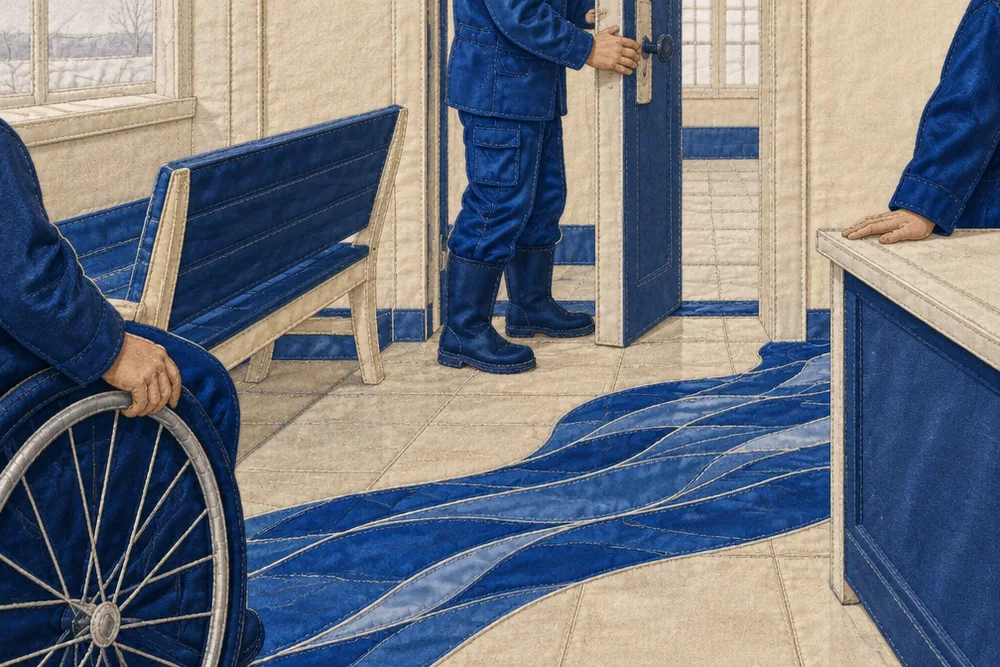
Piers looked at the taped geometry. His first impulse was to shift the waiting room into the former laundry, but the door swing and the wet-room route made that a paper answer. The cooperative needed the hall for passengers; Cora needed it for classes; neither use could be treated as decoration around the other.
“Could the bench sit at an angle?” the passenger asked. “Not straight along the wall. Turn it so its end faces the entrance. Then there’s room to come around.”
Piers looked at the tape. Forty degrees, perhaps a little less. It would break the tidy symmetry of his first instinct, though he had not drawn that instinct anywhere. More importantly, it might preserve a clear route without moving the ticket line into the doorway.
“Let’s test it,” he said.
He lifted one end of the bench. The deckhand took the other, and together they pivoted it. Piers kept his hands under the weight, not on the passenger’s chair. They set it down along a fresh strip of tape, angled toward the entrance. The passenger rolled through the gap, turned cleanly and reached the ticket table without reversing. The trolley passed too, its wheel clicking once against the edge of a grout line.
“That’s better,” Ede said. “But people will leave bags at the end.”