A Fuel-Free Tram for a Baker’s Name
Page 38 of 227
Chapters
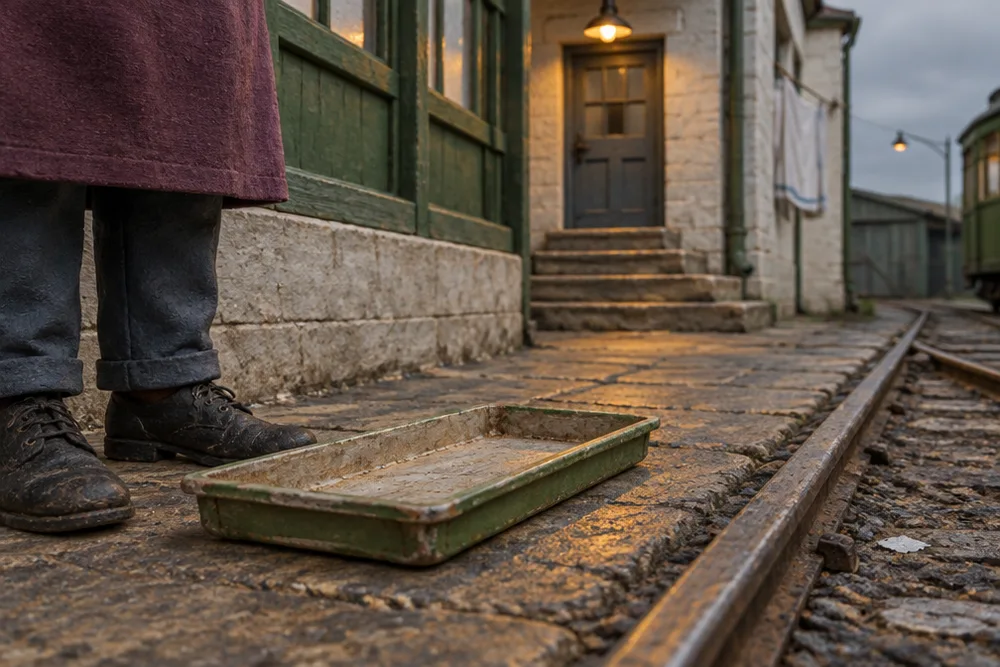
The lower track ran beside the depot wall, then past the laundry’s back door and a row of steps worn shallow in the middle. Iona followed, carrying a coil of measuring cord. Sef came behind them, keys clinking. Kit stopped at every place where a worker might wait, setting the tray down on the ground and looking around as if testing the space with their body.
At the first door, a laundry sorter pushed out a cart with a wet bundle strapped across it. Kit stepped aside to let her pass. The cart’s front wheel snagged on a cracked paving seam. She lifted the handle to force it through, shoulders straining.
“That’s not a boarding place,” Kit said. “Too narrow for a tray, let alone a person with a load.”
Iona marked the wall with a small chalk cross.
They walked on. The line descended by a shallow grade toward the lower terrace, where the glass roofs of the depot cars showed through the yard fence. A broad patch of stone lay near the laundry walk, wide enough for two people to stand without blocking the door. It was not an official platform. No sign named it. A drain cut through one edge, and the stone had a worn pale stripe where bundles had been rested.
Kit placed the tray on the stripe. “People already stop here.”
“They stop because there’s nowhere else,” Iona said.
“That’s still information.” Kit folded at the hips to listen as a pair of laundry workers talked behind the door. One complained that the stair chain took too long to assemble; the other said she could not leave a load unattended. Kit did not interrupt. They waited until the workers went in, then looked at Iona.
“If the tram ran, would they board here?” Iona asked.
“They might. But don’t put that in a sketch unless you ask them.”
“I’m not drawing a platform yet.”
“Good.” Kit retrieved the tray and walked farther along the line, past the lower terrace’s bakehouse alley. The alley hatch at Last Loaf was shut. A bench stood beneath it, its seat scarred by flour sacks and damp coats. Kit touched the bench with their free hand, then continued without explaining.
Iona added another chalk mark by the stone. “You’re seeing the stops people use.”
“I’m seeing where they put things down. That’s usually the first clue.”
The line tightened beside a low wall and curved toward the depot haul track. From there the climb up to Salt Elbow was short, but steep enough that Iona could feel the pull in her legs just looking at it. Above, the old passing platform’s edge stood higher than a car floor. She stared at the bend and began measuring distances with her eyes.