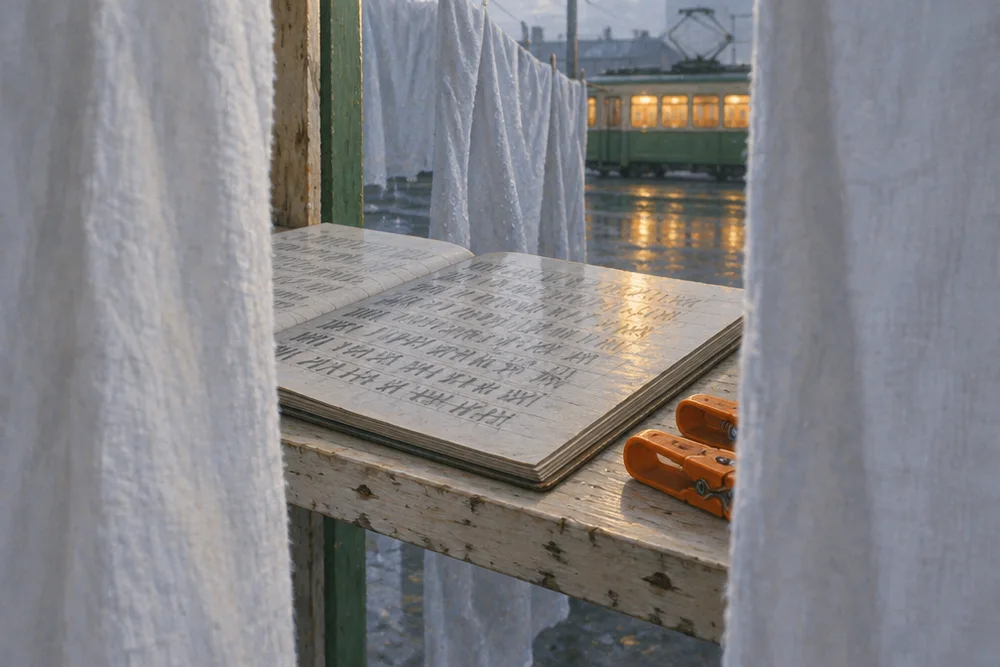
A Fuel-Free Tram for a Baker’s Name
Page 129 of 227
Chapters
The sorter who had paused at the map stepped closer. Their long fingers hovered over the times. “I waited longer than forty-two on Tuesday. That’s when the second load came back down.”
Mara made a small mark in the margin. “Then we’ve been generous to the stairs.”
A few people laughed—not loudly, but enough to loosen the bridge’s tight quiet. Kit felt their shoulders ease. Mara had brought proof, not a plea. The work itself was there in ink, and no one had to turn Kit’s private glimpse into public property to see it.
Nemi took off her spectacles, cleaned one lens with a square of cloth, and put them back on. “The question before us is narrower than whether this route fixes every delay. We’re deciding whether to release materials for the landing and shared walk.”
“And who maintains it?” the merchants’ representative asked.
“That cost is in the proposal,” Iona said from beside the rack. Her leaf-green vest was smudged with chalk. She held her square block in one hand, thumb whitening its edge. “If the landing is shared, the tram budget has to maintain the walk. Otherwise the laundry pays for the town’s stop.”
Kit glanced toward her. Iona sounded certain, but she had learned to name costs only after somebody else named them first. Today she had named one herself.
The representative examined the map again. “The upper terrace pays into the same reserve.”
“And gets the first slots,” the sorter said. “We’ve all seen the tickets.”
“Those slots keep merchants’ deliveries from spoiling.”
“So do night workers’ hours,” Mara said. “They just don’t come with a colored ticket.”
Kit felt the argument tug toward a familiar trap: people proving which hardship deserved to count. Their apron pocket held the copied consent clause. That was the dispute Nemi had asked them to bring into the room. The people waiting for loads were the reason it mattered, not a distraction from it.
They unfolded the copy and set it beside the tally sheets. “The clause says a person’s refusal can be overridden once the town enters their name. It doesn’t say their work becomes theirs to choose later. If we’re deciding whether to build a stop, don’t make this into a question of whether I saw a good enough picture to be allowed a say.”
Nemi’s eyes dropped to the form. “I’m not asking the council to put your name in the ledger today.”
“Not today,” Kit said. “But the enrollment sitting is still coming.”