A Cup for the Uncounted
Page 90 of 241
Chapters
Mera glanced at Carys, not asking her to decide, only letting her stand in the conversation. Carys thought of the slate columns, the uphill trips, the hours they needed for the trough and the repair. “A little more won’t cover the work,” she said. “And every other week still takes the morning.”
Mrs. Brindle’s face softened by a fraction. “Then I won’t ask you to do it for less.” She took the basket’s handle. “I’ll ask at the hall. Someone there may want the work.”
Mera handed over her side. “Thank you.”
They walked back without the weight. Carys had expected relief to feel like triumph. Instead it felt like a space opened in a crowded room: useful, but with the echo of what had been removed. At home, Mera wrote the final payment into the slate and crossed the contract from their list. The chalk line was straight and pale.
“One less basket,” Carys said.
“One less basket, and two mornings returned.” Mera shut the slate. “That’s what we bought.”
They cleaned the trough that afternoon. Carys scraped away the soap scale with a wooden spatula while Mera carried pails of clean water from their indoor tap. The first rinse came away gray. The second showed the stone’s original pale color in streaks. At the outlet, the plug still resisted; they left it soaking in vinegar rather than forcing it and cracking the stone.
Mera stitched a hem around the waxed cloth. Her needle went through the old material with a squeak. Carys held the seam taut and watched water bead on the surface when Mera tested it from a cup.
“It’ll hold a covered load for a few hours,” Carys said. “Not overnight.”
“We won’t leave it overnight.”
“And whoever draws from it has to know which water is theirs.”
“A mark on each bucket, or a measured scoop.” Mera tied off the thread. “No names.”
Carys nodded. This was the sort of rule she could explain to Perrin without asking him for anyone’s household roll. She also knew the trough could turn into a bottleneck. If people arrived together, the smaller cups would wait while the larger ones filled. The model counted priority, not volume, but bodies at a basin could still make their own order.
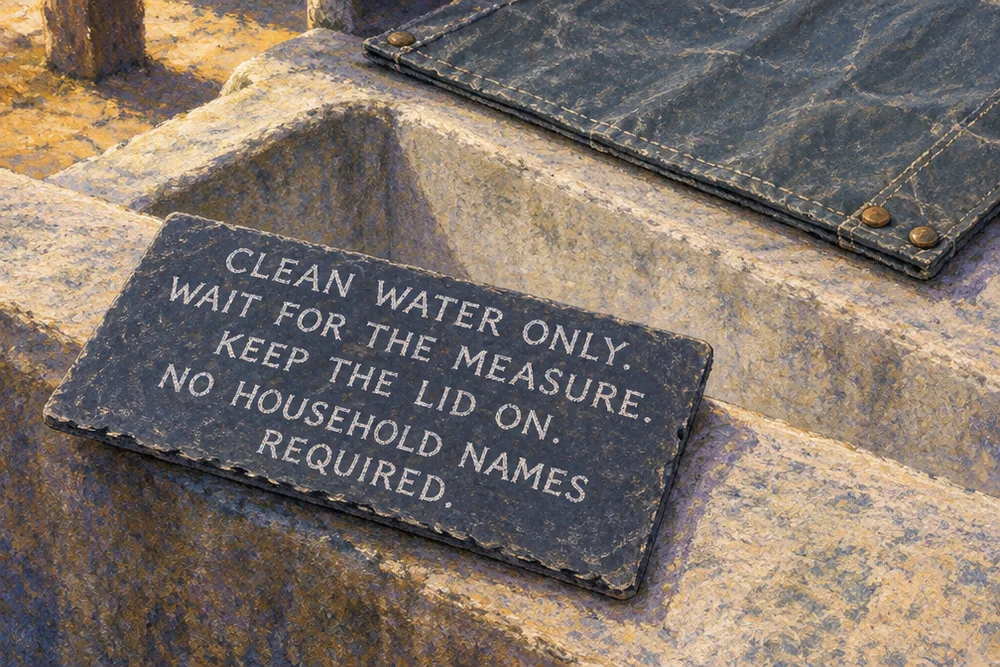
She took a strip of slate and wrote: CLEAN WATER ONLY. WAIT FOR THE MEASURE. KEEP THE LID ON. She paused, then added: NO HOUSEHOLD NAMES REQUIRED.
Mera read it, lips moving over the last line. “Good.”
“It may make no difference if the bypass is broken.”
“Then we will have a clean trough ready when it isn’t.”