A Cup for the Uncounted
Page 86 of 241
Chapters
“I can carry the Brindles,” Carys said. “If I take the whole contract, you can rest more.”
“You’ll carry it uphill, wash it, dry it, and bring it back?” Mera asked. “And attend the test Iven may or may not allow? When will you sleep?”
“I can do more.”
“You can do what one person can do.” Mera lifted a sheet by two corners and snapped it open. “The Brindles have never paid for the hours this takes. I kept them because I didn’t like turning away work. That is not the same as needing it.”
Carys picked at a loose hem thread. She knew the account: soap, fuel, the worn leather belt on the mangle, and the days when rain kept linen from drying. Mera had shown her how to tally costs when she was twelve, though she had never made Carys use the figures to justify a decision about their own household.
“If we drop them, you lose coin,” Carys said.
“Some coin.” Mera’s face was square and tired, her hooded eyes fixed on the stitching. “And I get back two mornings, plus the climb. We keep the households that pay enough to cover what they use. We stop pretending every basket is worth carrying.”
The Brindle sheets lay between them, white against the scuffed bench. Carys imagined the empty space they would leave in the weekly stack. She also imagined Mera’s hands after a day of hauling: knuckles swollen, wrists red where wet cloth had dragged against them.
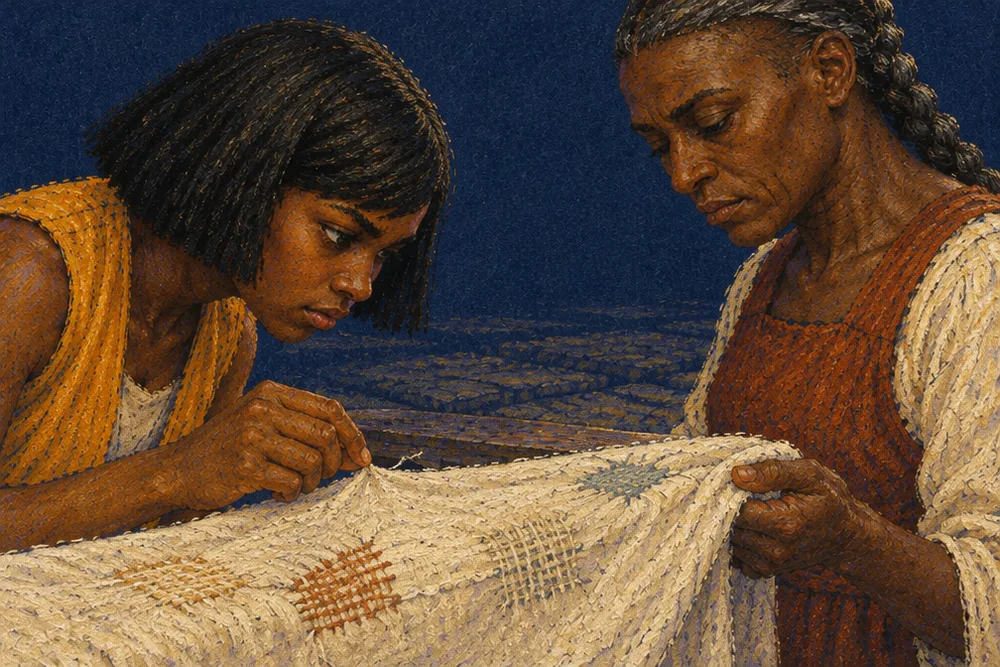
“I could still quit,” Carys said, more quietly. “Then the lost money wouldn’t matter as much.”
Mera set the sheet down. “Listen to yourself. You’re offering to make your life smaller so I don’t have to change a schedule.”
“I’m offering to help.”
“Then help me choose what we stop doing.” Mera pushed the basket toward her. “Not what you stop becoming.”
They made the account at the kitchen table, where the plank dipped toward the middle and caught crumbs. Mera found her slate and chalk. Carys listed each contract, the number of trips, the soap used, and what came back in coin. She wrote the Brindles last, though she knew the figures by heart.
Their other work was steady: two families on the lower Middle stair, a baker’s flour wraps, and the hall’s towels after ceremony days. The Brindles’ sheets took more water than any of them and paid less per load. Their income looked respectable only because the basket came so often.
Mera studied the columns. “We can tell them the truth. We’re giving up the contract because it costs us more than it returns.”