A Cup for the Uncounted
Page 173 of 241
Chapters
“We can give them a measured share and a way to stop the flow if the route fails.”
Iven’s eyes stayed on the figures. “And the businesses?”
“They’ll lose water.”
“How much?”
“More than half their usual trade draw on the lowest days.”
The sentence felt too large for the table. She had imagined a clever arrangement that would smooth the worst of the shortage. Instead, the numbers made the cost visible: Sella’s ovens could not be fed as before; Mera’s laundry contracts would not all fit; other trades would have to turn work away or change their hours. No rotating cup could keep every business whole when the spring itself had thinned.
Carys gathered the measurements into a stack. “Tomorrow we take this to the delegates. We ask them to choose the trade cap together.”
“They may choose to keep the old order.”
“Then they’ll be choosing who stays dry.”
The next morning, Carys found Mera in the yard, lifting a basket of damp linen onto the narrow handcart. A length of cord had snapped, and Mera was knotting it around the handle with her thick forearms braced against the basket’s weight. The rust apron she wore was darkened at the hip from the wet load.
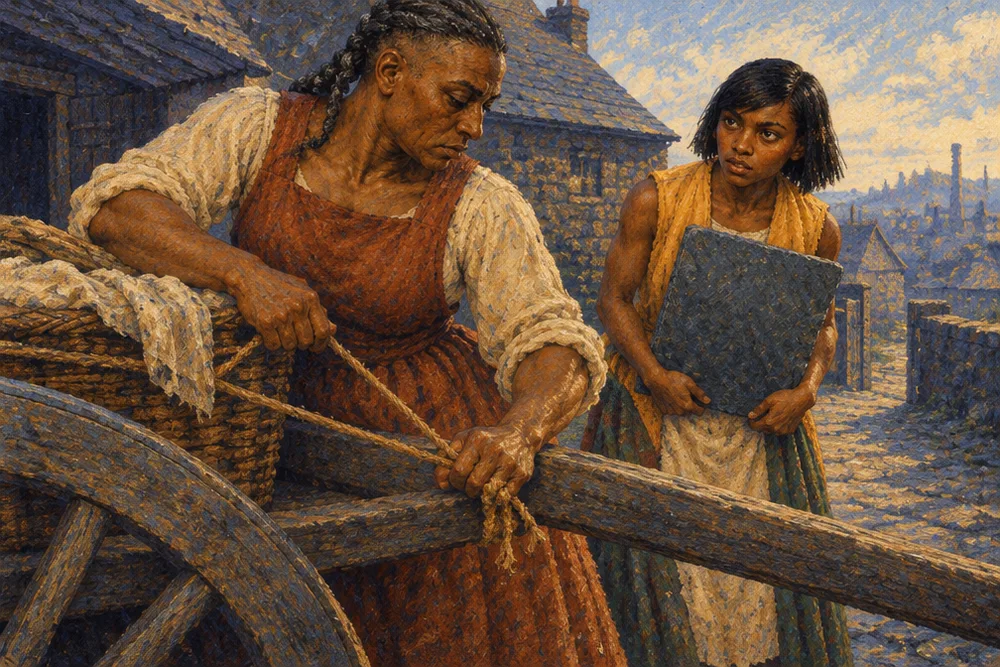
“The lower contract?” Carys asked.
“The client wants the sheets before midday.” Mera pulled the knot tight. “I can do it if I get the usual rinse.”
Carys held the slate against her chest. The measurements were written in a careful hand, though the figures seemed less steady than they had the night before. “The low-flow plan gives households a measured minimum first. After that, trade water is capped. I think the cap will cut the laundry allotment by more than half on the lowest days.”
Mera tested the cart handle. “Then I’ll lose the contract.”
“Maybe. We haven’t asked the delegates yet.”
“You have asked the numbers.” Mera stood hip-shot, studying Carys’s face beneath her shaved temples and gray-streaked braid. “You’re trying to make the answer gentler by saying maybe.”
Carys swallowed. “I don’t want you to lose work.”
“Neither do I.” Mera shifted the basket onto the cart. “But you don’t get to make the spring stronger by keeping me ignorant.”
That was what Iven had said, in a different way. Carys looked at the laundry, the single contract that might still fit if the turn came early enough. Her apprenticeship wages could have helped replace what Mera lost. She had wanted the job because it was a route out of this yard, and because it might ease the work that bent her mother’s shoulders forward. She could not make those wishes a reason to hide the measure.