A Bell for the Way Back
Page 214 of 279
Chapters
At the next saddle, the route divided around a collapsed parapet. One branch sloped toward the belfry by way of a roof still marked with blue chalk. The other was wider, but led down to a landing already edged in green water. Zella tested the chalked branch with her toe. The stone felt firm. She took it.
The water below lapped at the landing’s lowest step. The step did not rise; it was not one of the sampled thresholds. It simply waited under the tide, a fixed piece of stone at the wrong height. Zella understood the difference now in her body as much as in the machine’s rules. The route was being given back one threshold at a time, but the ground under the village was not sliding down with it. The old datum held. The borrowed strip was what went.
She moved more quickly, though not carelessly. If the float lifted before she had fixed the bell on the arm, she might reach the tower in time and still fail to give the mechanism anything it could strike. She pictured the curved bedding piece under the frame: its grain running across the bearing, the cut surfaces she had marked twice, the two sides of her signature separated by sawdust. She had left the long strongback for the bay. The remaining hull sections could be joined later, if later had a place to work.
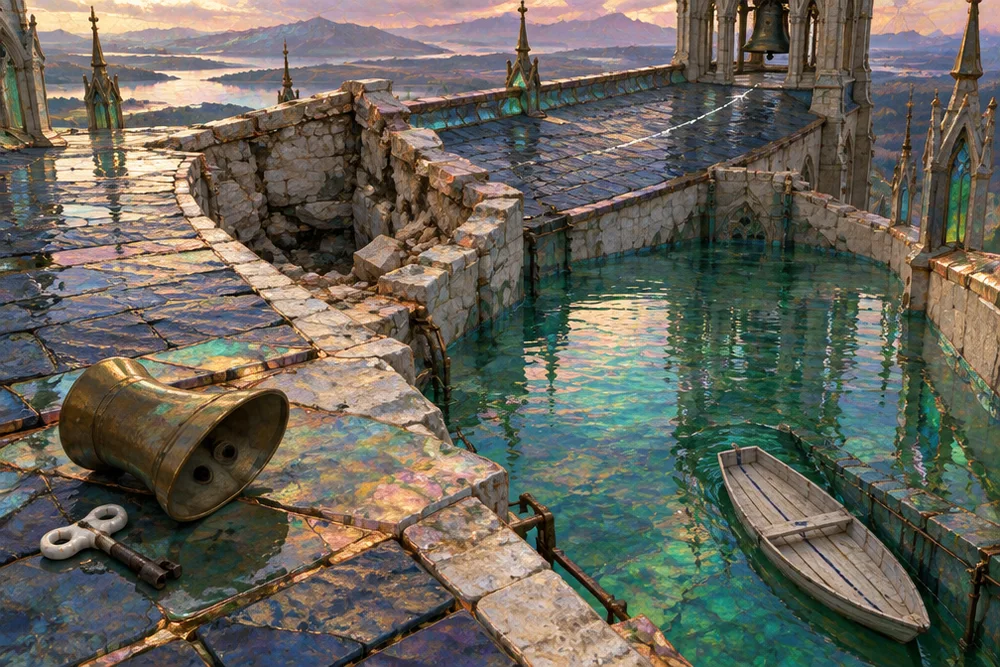
The chalked branch ended at a low roof junction. From there, a stone saddle climbed toward the belfry wall. The opening was close enough to reach, but the last step was steep. Zella crouched and set the bell against her knee. She could climb with both hands free, then lift it through the arch. The roof beneath her carried a shallow sheet of water, and a thread of it ran between her boots.
She tucked the bell into the crook of her left arm and climbed. Her right palm found a rough seam in the stone; her left forearm held the brass steady against her ribs. The saddle’s upper edge was polished by wind and old feet. She reached the tower ledge and rolled one knee over it, then drew the bell up after her.
Inside the arch, the air smelled of wet limestone and iron. The reaction frame was fixed to the inner wall above the tidal throat. Its horizontal arm had been worn flat at the bearing, the old brass rounded by years of movement—or by years of being asked to move without the bell. The float below sat at the bottom of its travel, a dark shape among the narrow channels of water.