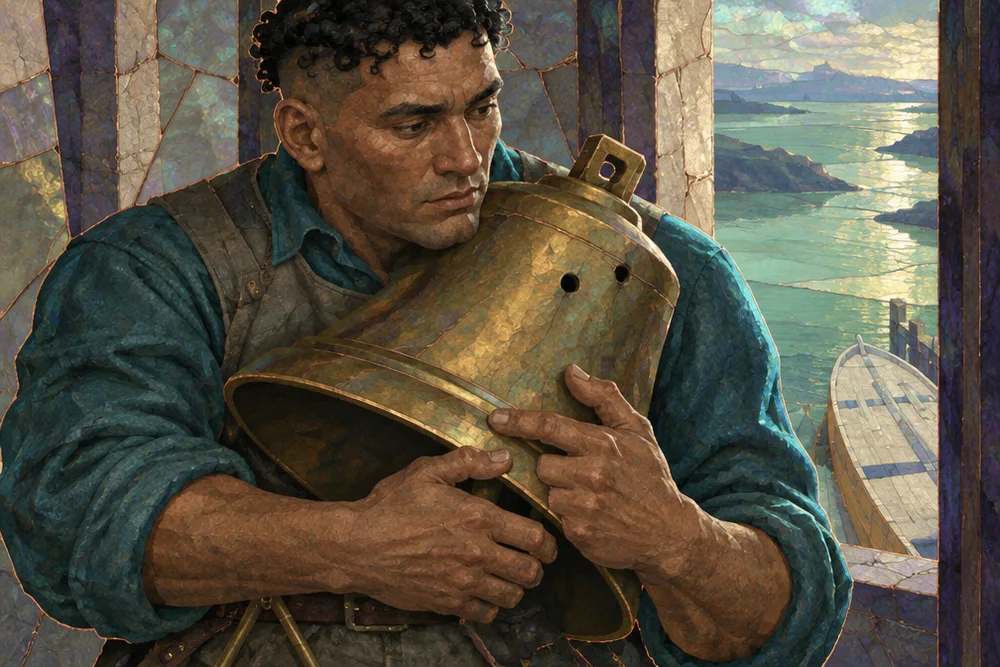
A Bell for the Way Back
Page 160 of 279
Chapters
The arm came to rest. She set the strip to the collar, wrong way round first, on purpose. It looked good from above. Only when she pressed the marked corner into place did the far end lift. She turned it back and felt the paper settle into the flattened place. Not a pattern to cut straight to, then. Something to keep her from bringing back a piece she could only make fit by taking too much off.
Tavin stooped to retrieve the bell. He folded the cloth back off its mouth but left it on the boards for the moment. “Do you need my hands up here when you fit it?”
“For the first trial. I want to watch it from underneath while you move the arm.” She glanced down at the black cut in the floor. “From these boards. No farther.”
“And I leave the bell down.”
“We both leave it down.”
He picked it up then, one hand through the eye and the other cupped across the mouth. She could see him feel the pull on his wrist as he straightened. He changed his grip rather than fight it. That was what the fitting had to do, though it had less than a finger’s breadth in which to do it.
Zella slipped the paper flat behind her rule, where the crease wouldn’t be rubbed out by the tools. Tavin had stopped looking at her hands. He was looking at the gap itself now, from the shoulder in the brass to the narrow passage beside the stone. She put a finger on the worn place so he could see where the piece would have to begin.
“A curved bedding piece,” she said. “Wood, seasoned, close-grained. It’ll sit between the shoe and the worn collar and stop it rolling. The shape has to match the bearing’s curve, and the piece has to be tight enough not to creep when the float comes up.”
Tavin looked around the belfry as if a suitable piece might have been left on a shelf. There were only old pegs, a coil of brittle rope, and the dark iron frame. “There’s no spare timber up here.”
“I know.”
“The roofs have battens.”
“Too thin. They’d split under pressure.” Zella laid the seam iron across the collar again and studied the gap. Her fingers measured a curve in the air, then traced the edge of the worn brass. “I need stock that’s thick enough to shape, but not so hard it cracks when we seat it. And it needs to be dry all the way through.”
“The village has been wet for eleven years.”