A Bell for the Way Back
Page 114 of 279
Chapters
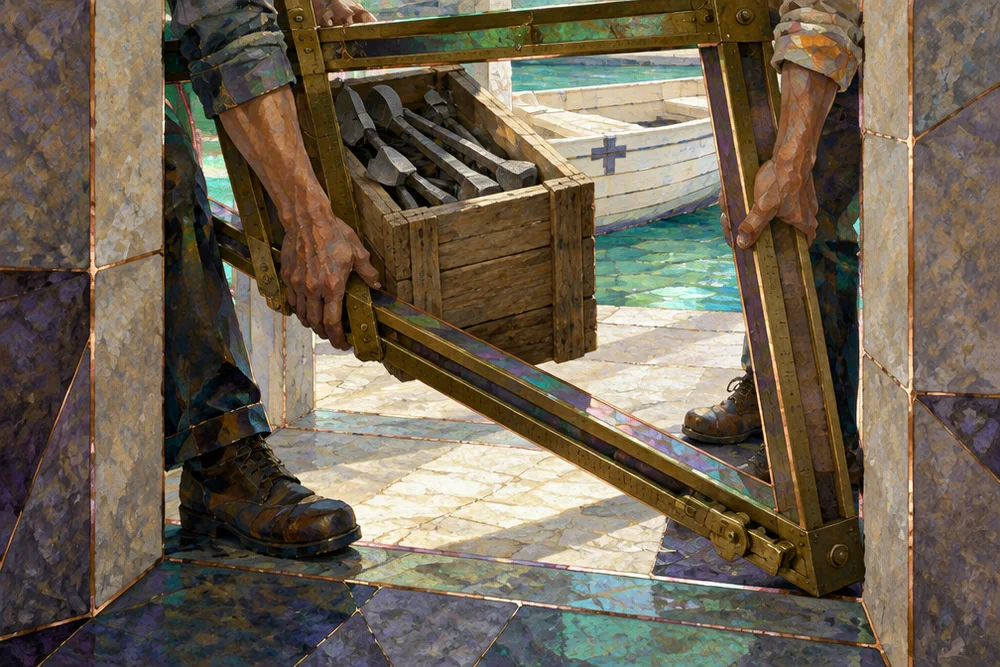
The next load included the measuring frame and a crate of seam irons. Two people carried the frame sideways, carefully turning it through the narrow approach. Its brass corners caught the daylight. Nera walked beside them, one hand under the lower rail, calling small corrections as they reached the bend. “Keep the short end forward. Tilt toward the wall. Now bring it level.” The frame cleared without striking stone. At the ledge, the carriers set it down over the chalked patch Zella had left open. Nera checked its feet, then placed a wedge beneath one corner. The frame sat level enough for work. “That’s where I’ll use it,” she said. The space was no bigger than a broad table, but she could stand on either long side. The shared tools had been placed along the back edge, and the personal bundles sat in labelled stacks that left a narrow aisle open. Zella made a mark on her plank. The first tool station had become a real place, not just a promise. Mett arrived with a short bench section. The boy carried one of the legs, held against his shoulder. He kept his free hand on the wood to stop it from swinging. At the ledge entrance, Mett took the opposite end. “Watch your fingers,” he said. “I know.” “Knowing and keeping them clear are different jobs.” The boy moved his hand. They turned the bench section through the bend and brought it to the open space beyond the measuring frame. The ledge’s exposed edge was only a few steps away. Wind lifted the cloth covering a bundle of planes. Zella weighted it with a seam iron. “This section can be supported on two crates,” Mett said. “The legs will make a frame.” “If we leave a passage behind it,” Nera added. “No one works with their back against the drop.” Mett set the wood down and checked the gap to the rock wall. “The passage goes here. The frame goes there.” He turned to the boy. “Measure the clearance.” The boy set down his leg and took the cord. He measured from the wall to the bench section, then from the bench to the marked aisle. “Enough for one person to pass with a small bundle,” he said. “Not a crate.” “Then crates stay at the outer stack,” Mett answered. The boy marked the limits in chalk. The section had a place, and so did the people who would work around it. They had carried a bench top, a leg, and a measuring frame into a space that could not house a workshop. It was still enough to begin making decisions from the other side of the red line.