A Bell for the Way Back
Page 105 of 279
Chapters
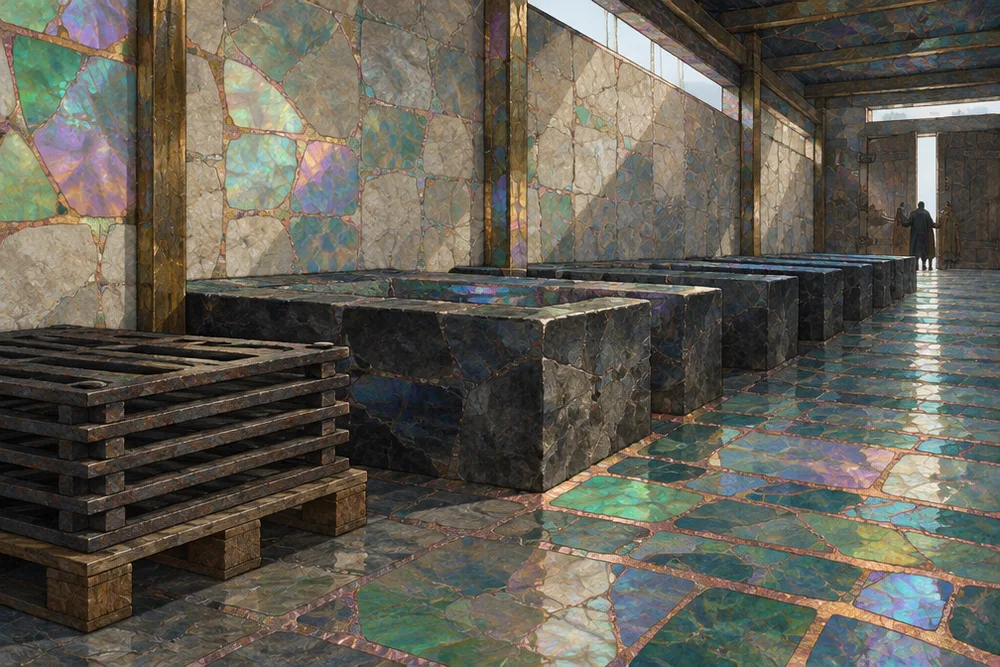
The room beyond the shelves smelled of damp rope and old smoke. Its kiln beds stood in a row, broad blocks of stone faced with iron grates. The beds were too heavy to move intact and too useful to abandon without a plan. Workers had already taken the removable grates and stacked them on a low pallet. A pair of renters knelt by one kiln, easing a cold iron door off its hinges. Their movements were slow and precise. They had all seen what happened when a heavy object slipped on wet limestone. “How many can the ledge take?” Mett asked. “Not the beds,” Zella said. “The grates, the doors, the tools. Anything that can travel in pieces.” “And the rails?” “Short ones can go. The long floor rails won’t make the turn.” She had seen the approach at Needle Ledge and had helped measure it. The passage narrowed between two shoulders of rock. It could admit a person carrying a plank, if the plank was short enough to pivot. A long rail would catch before its far end cleared the bend. Mett crouched by the nearest kiln, his weight settled over his heels. He touched the iron rim, then ran a thumb along its soot-blackened edge. “We can cut the beds?” asked a renter. “They’re stone,” another said. “Cutting them will split them where we don’t want.” “Could set wedges—” “Not on the last ebb.” Their talk crowded the room. Zella looked at the red stripe as it passed beneath the kiln row. The line was level at this point, not following the room’s uneven repairs. It marked the reach of the borrowed bank, not the highest place water might touch. That distinction mattered. It meant the beds could remain where they were for the few hours the workers still had, but it did not promise a way to save them. Mett stood. “Strip what comes off cleanly. Mark every piece. We don’t turn a useful door into scrap because we’re frightened of the clock.” The renters returned to their work. One wrapped the kiln door in sacking. Another wrote the kiln number on a tag and tied it to the grate. Zella painted the stripe past the last bed. The bristles caught against a hairline crack in the floor, and she eased the brush over it without forcing paint down into the seam. The line came out thin on the far side. She touched it up with a smaller brush. Near the doorway, a stack of timber rested on trestles. Several lengths could be divided, but the two longest were part of a floor rail system that held the workshop level. Without them, the bench floor could not be made true again by simply laying new boards across the old supports. Zella set the paint pot down before she reached them.